When people shop for a custom mascot, they tend to obsess over the fur color and the face, and then treat the head as a single thing they either like or do not. But the head is not one decision, it is two: the outside look and the base underneath it. That base, the rigid or semi-rigid structure the foam and fabric are built onto, is what determines how heavy the costume feels after twenty minutes, how well the character still looks in year three, and how much a second copy will cost you. Get the base right and everything else is styling. Get it wrong and no amount of good fur hides a head that has gone soft or grown too hot to wear.
The base sets the ceiling on comfort and lifespan
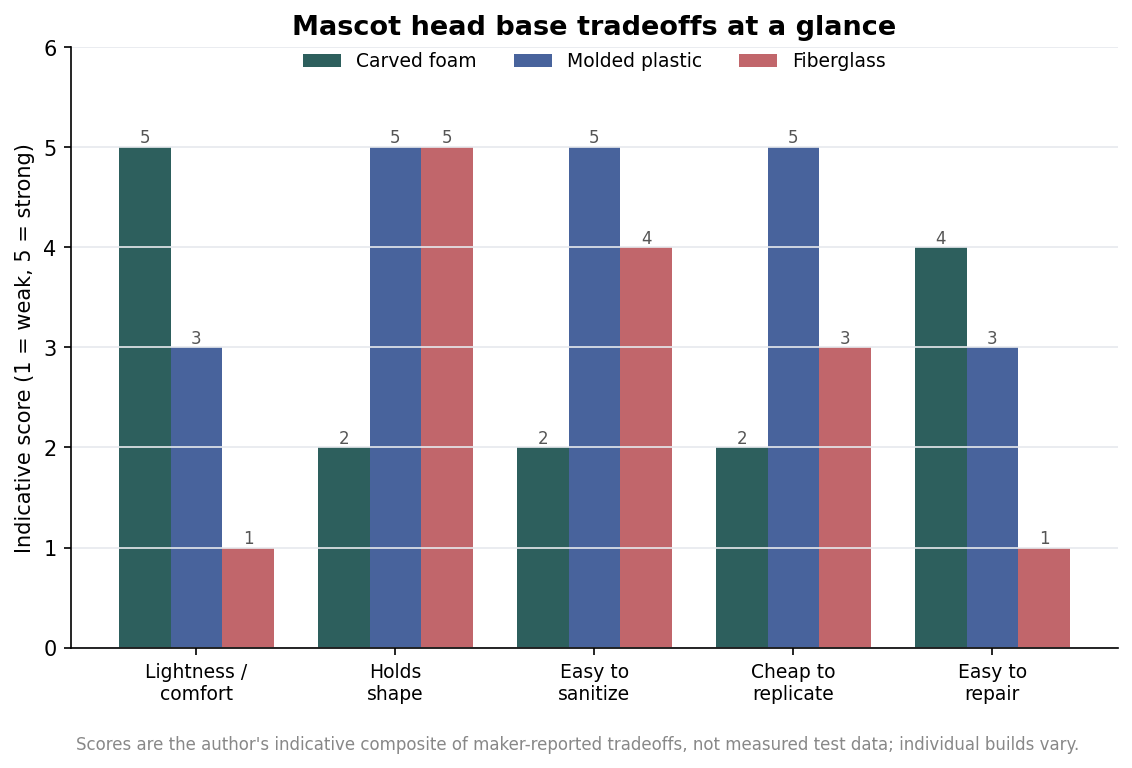
Three construction approaches dominate custom mascot heads today, and they trade off against each other in predictable ways. Carved closed-cell foam is the lightest and most forgiving to wear. Vacuum-formed and molded plastic bases are heavier but hold their shape and clean up far better. Fiberglass and resin shells, once the default for professional sports characters, are the most durable in raw terms but carry real penalties in weight and repairability. No single option wins on every axis, so the honest question is not “which is best” but “which set of tradeoffs fits how this costume will actually be used.”
Carved closed-cell foam: light and lively
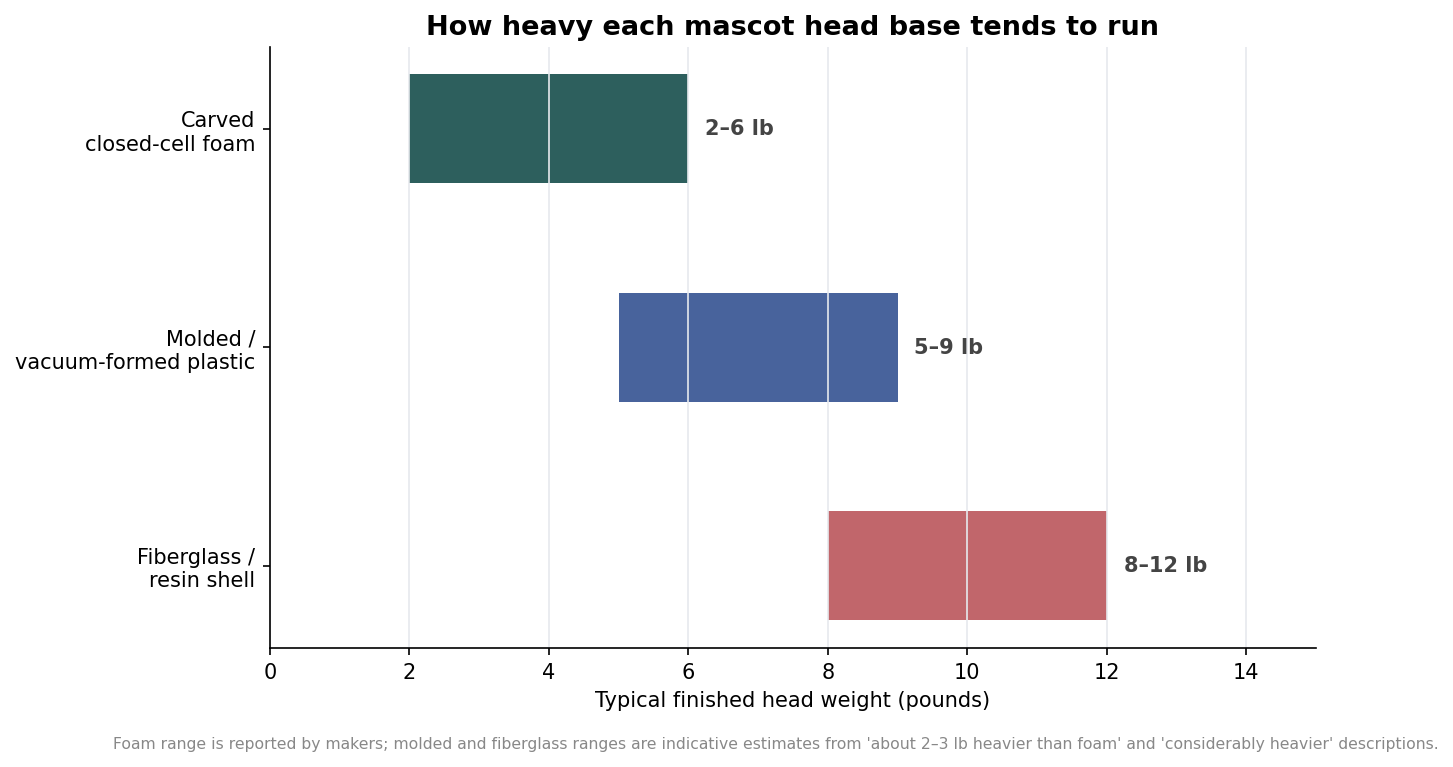
Foam heads are sculpted by hand from closed-cell foams such as ethafoam or plastazote, and their great virtue is weight. A carved foam head typically runs about two to six pounds, which is why performers who wear them for long shifts, school mascots and community characters especially, usually prefer them. The material forgives movement, sits comfortably, and gives an expressive, slightly soft look. The catch is longevity: foam gradually compresses and breaks down with use, so a head that looked crisp at delivery will soften over a few seasons and eventually want a refurbishment. Foam also costs more to replicate, because every duplicate has to be carved again by a skilled maker rather than pulled from a mold. One important caution: insist on closed-cell foam and avoid open-cell upholstery or craft foam, which traps sweat, breaks down faster, and invites mold.
Molded plastic: heavier, but it holds
Vacuum-formed and molded plastic bases start from a permanent mold, and that changes the economics and the durability at once. These heads commonly land two to three pounds heavier than an equivalent foam build, so larger characters sometimes need a padded shoulder harness to carry the load and protect the performer’s neck. In exchange, the head keeps its exact shape for its whole life, resists the slow sag that foam suffers, and wipes down easily, which matters a great deal when several people share one costume. Because the mold already exists, second and third copies are cheaper than hand-carved foam duplicates. If you need a mascot that looks identical across a fleet of schools, franchises or seasons, molded construction is usually the better long-run value even though it asks more of the wearer day to day.
Fiberglass and resin: the fading heavyweight
Fiberglass shells were the professional standard for decades and still turn up on big-league characters that need to survive rough handling. They are rigid, hold fine detail, and are genuinely tough. But the drawbacks are why modern makers have largely moved on. Fiberglass is the heaviest of the three, it off-gasses for a long time after manufacture, and it is expensive and difficult to repair once cracked. A damaged foam head can often be patched; a cracked resin shell frequently needs a specialist. For most buyers outside professional sports, the weight and repair penalties outweigh the durability advantage, and a well-built molded plastic base delivers most of the toughness with far less strain on the performer.
Airflow is part of the base decision
Whichever base you choose, heat management is not an afterthought bolted on at the end; it is shaped by the construction itself. Molded and fiberglass shells are rigid, so vents have to be planned into the mold and the mesh openings for eyes, nose and mouth do most of the breathing. Carved foam is easier to open up after the fact, but the foam still holds heat against the head. A powered fan is an option many buyers add, and the practical guidance from makers is to use a removable, reversible fan so it can pull stale air out or push fresh air in, running off a standard nine-volt battery for a reasonable balance of airflow and noise. It is worth knowing that a lot of professional-grade heads skip fans entirely and rely on generous passive venting and short performance windows instead, because a fan is one more thing to fail mid-appearance. Plan the venting strategy at the same time you pick the base, not after the head is already built.
Matching the base to the job
The right choice follows the use case rather than a ranking. For long wear times, younger performers and comfort-first programs, carved foam is the natural pick and you plan for periodic refurbishment as a maintenance cost, not a defect. For shared use, multi-year deployment, easy sanitation, or any situation where you will order more than one identical copy, molded plastic earns its extra weight. Reserve fiberglass for cases where maximum rigidity and detail genuinely justify the heaviest, least repairable option. Whatever base you choose, the finishing details decide how long it lasts: look for sewn rather than glued fabric seams, strategically placed vents at the sides, top and back with mesh behind the eyes, nose and mouth, and removable, washable padding so the fit can adjust across wearers. Those details, more than the fur, are what separate a head that ages gracefully from one you are replacing far too soon.