Two very different questions hide inside the phrase flame-retardant costume. One is whether the garment is legal to sell in the United States at all, which every piece of clothing has to answer. The other is whether a specific venue will let it onto a stage full of lights, quick changes, and sometimes pyrotechnics. They are governed by separate rules, tested by separate methods, and satisfied by separate paperwork, and a costume can clear one while failing the other. Knowing which question you are actually asking is the difference between a smooth load-in and a fire marshal turning your performer away at the door.
The floor: what every apparel item must pass
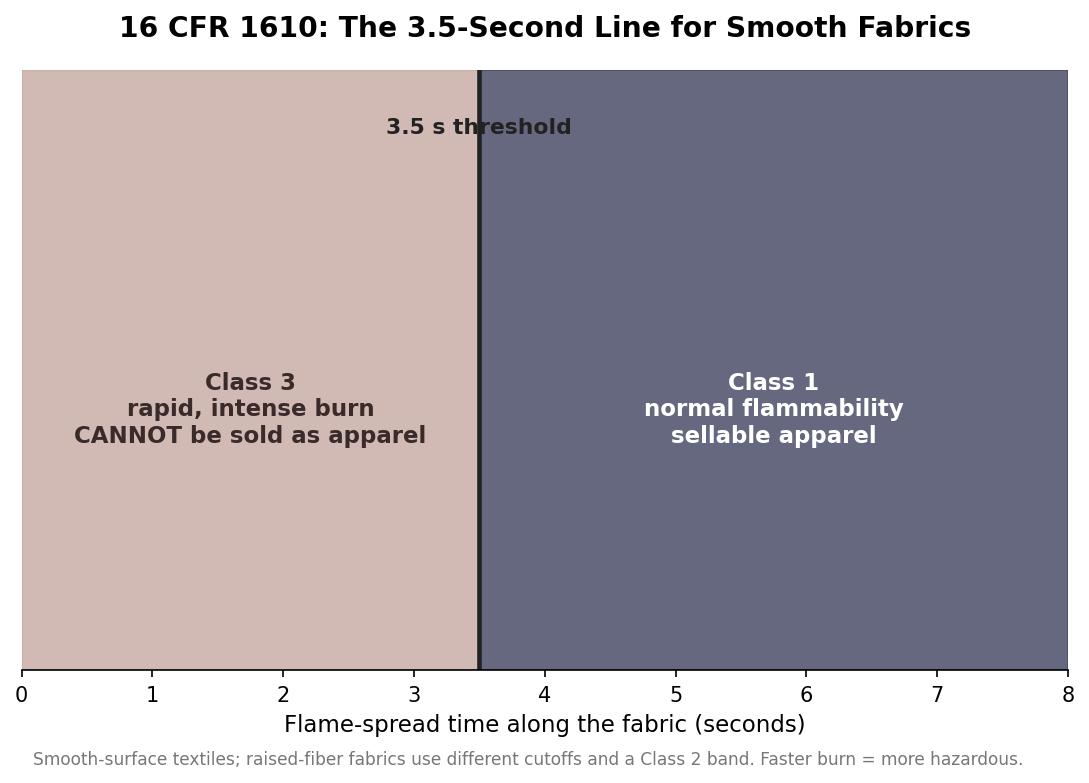
In the U.S., anything sold as wearing apparel falls under the Standard for the Flammability of Clothing Textiles, 16 CFR Part 1610. It sorts fabrics into three classes by how fast a flame travels across the surface. Class 1 is normal flammability and is the ordinary, acceptable result. Class 2 is an intermediate rating permitted only for certain raised-fiber fabrics. Class 3 is rapid and intense burning, and clothing made from Class 3 fabric cannot be sold in the country. For smooth-surface fabrics, the dividing line is a flame-spread time of about 3.5 seconds: faster than that and the material fails into Class 3, slower and it clears as Class 1. Raised-fiber fabrics, the fuzzy and napped surfaces, are judged on a different scale that adds the Class 2 band. The important thing for a costume buyer is that this standard is a minimum, not a mark of fire safety. It keeps dangerously flammable cloth off the racks, but a Class 1 rating does not mean a garment is flame-resistant in any meaningful stage sense.
The stage question: venue fire codes and NFPA 701
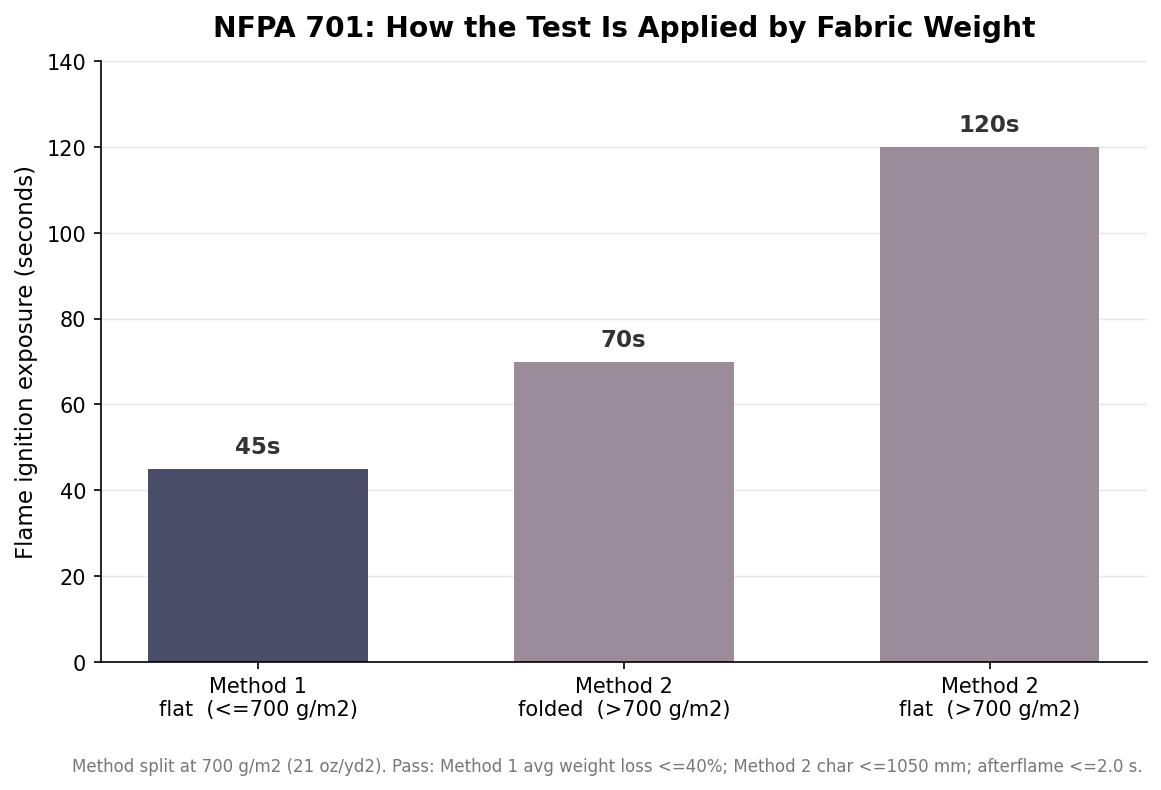
Put a costume under theatrical conditions and a second body of rules takes over, written not for the manufacturer but for the building. Public-assembly venues enforce fire codes that frequently call for flame certification on textiles, and the test most often named is NFPA 701, the Standard Methods of Fire Tests for Flame Propagation of Textiles and Films. It was designed for hung materials, curtains, drapes, backdrops, banners, and the large soft goods that surround a performance, and venues sometimes extend the same expectation to oversized costume and prop pieces that behave like scenery. The standard picks its test method by fabric weight. Lighter materials at or below 700 grams per square meter run Method 1, with a 45-second flame exposure, and pass only if the average weight loss across specimens stays at or under 40 percent. Heavier or coated materials above that weight run Method 2, with longer exposures of 70 seconds folded or 120 seconds flat, and are judged on char length, which may not exceed 1,050 millimeters. In both methods, afterflame and any flaming drips must self-extinguish within about two seconds. In California, a separate state program, Title 19, registers flame-retardant materials and treatments, and venues there often ask specifically for a Title 19 certificate. None of these is a garment-sale law; they are conditions of entry that the venue, not the maker, imposes.
How the resistance is built in, and whether it survives the wash
There are two ways a costume becomes flame-resistant, and they age very differently. The durable route is inherent resistance, where the fiber itself resists ignition. Modacrylic and other engineered fibers carry their flame behavior in the chemistry of the material, so laundering does not strip it away. The other route is a topical treatment, a flame-retardant chemistry applied to an ordinary fabric after the fact by soaking or spraying. Topical treatment can bring a flammable base cloth into compliance and is often the practical choice for a specific look or color, but it is not permanent. Washing, dry cleaning, sweat, and time all erode it, which is why a treatment certificate is only valid for a stated number of launderings or a defined service window, after which the piece needs re-treatment and, strictly, re-testing. For a costume that will be worn hard and cleaned often, inherent construction is the lower-maintenance answer; for a one-run show or a piece that is spot-cleaned, a certified topical treatment can be perfectly reasonable. Either way, the certificate is tied to the fabric as tested, so substituting a trim or a lining can quietly void the claim.
What to specify when you order
Start by naming the setting, because it selects the rules. If the costume is simply being sold or shipped to a wearer, the relevant answer is that its fabrics meet 16 CFR 1610, and most conventional costume textiles already do. If it is going onto a stage, ask the venue in advance which certificate the fire marshal will accept, since NFPA 701 and California Title 19 are the usual names, and get that requirement in writing before the fabric is chosen rather than after. Ask whether the resistance is inherent or topical, and if topical, how many launderings the certificate covers and what re-treatment will cost over the life of the costume. Ask that the flame documentation reference the exact fabric, color, and finish being supplied, because a certificate for a different weight or coating of the same material does not transfer. Build lead time in as well: sourcing a certified inherently flame-resistant fabric, or scheduling a treatment and its test, adds days to a custom build that a plain cotton version would not need. The costume itself is only half the deliverable. The paperwork that lets it perform is the other half, and it is far cheaper to specify at the start than to chase the week of the show.